Last New Year I was in Verona, Italy with a very special Italian girl. My Italian was very mediocre to the point where it became apparent my only exposure was on the flight over. I stunk at understanding people and worse, I couldn't really communicate without using English. As I watched the fireworks crackle over the huge crowd I made a vow to return to Italy and be better at Italian. It would be so cool to speak French fluently and then have some Italian on the side!
Fast forward one year. Not only am I eating great food and drinking great wine with the locals, but I understand so much! My comprehension skills have gotten better, ten fold, while my ability to express myself through words is improving everyday that I'm over here. I've received many compliments and was even told I have a "French" Italian accent (not an American one, so I guess that's a compliment).
But John, let's be honest, maintaining their New Year's resolutions can be difficult. Clean the garage, lose some weight, make more money... oftentimes, failure arrives before the end of January. However New Year's resolutions are possible if we approach them in the right way!
Did you ever have the desire to learn another language OR revisit what you learned during those younger years? Well, why not learn French? It's never too late to start and with a bit of motivation, you can find yourself in places you've never even dreamed about with people you still don't even know yet.
Let's talk about why you should learn a language and then examine some ways to go about this.
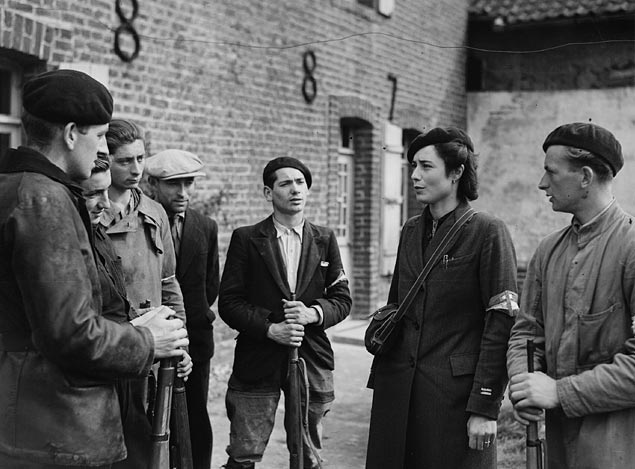
Have intermediate to advanced vocabulary and curious about the French Resistance during World War 2? Well then you'll enjoy the video and text transcription created by me (John Elkhoury), Annie Butkiewicz (1st girl speaker), and Bethany Kohlmer (2nd girl speaker) for our French history project. Check out what a couple American college students can do; try to listen to our speech and/or follow along with the transcription. Just so you know, we got a 100% on the project :D
Transcribed text from the video:
Les généraux français ont pensé que l’armée ne pouvait être vaincue. Mais tout s’est joué en quelques semaines. Le 10 Mai 1940, les Allemands ont commencé leur offensive par les Ardennes, un obstacle que tout le monde avait pensé infranchissable par une armée mécanisée. La stratégie française était celle de la grande guerre; une guerre défensive. Alors, l’armée allemande est passée à l’offensive en lançant un million de combattants et trois milles chars concentrés en Belgique et au Pays-Bas. Les troupes Alliés se sont alors dirigées vers la Belgique et ont été prises au piège. C’était la pagaille complète. Les soldats Alliés fuyaient comme des lapins. Après cette catastrophe, les Allemands ont continué à avancer vers Paris.
Après la capture de Paris, un nouveau gouvernement est installé à Vichy. Le Général Pétain devient le nouveau chef de l'état. Au début, le peuple a considéré Pétain comme un sauveur, mais il allait au-devant d'une grave désillusion.
Peu à peu, les politiques des allemands se renforçaient et le gouvernement de Vichy collaborait. Le service du travail obligatoire forçait les jeunes à trouver refuge dans les montagnes et les forêts, loin des villes. Les juifs étaient ostracisés et expulsés aux camps de la mort. La résistance est devenue une force contre l’occupation étrangère en vue de revenir à la France d’avant-guerre.
La résistance a commencée de façon sporadique. Les premiers mouvements de résistance étaient désorganisés, faibles, et la portée des objectifs était très limitée. Ces groupes résistants fonctionnaient sans contact, ni aide des Alliés.
En mille neuf cent quarante et un, Charles de Gaulle et un homme prénommé Jean Moulin se sont rencontrés à Londres. Moulin voulait unifier les trois grands groupes de la Résistance tout en recevant de l’aide logistique et financière. De Gaulle a confié à Moulin la mission de rassembler et de créer une armée sécrète. Avec le temps, tout s’arrangera.
La Résistance Française
La résistance était composée d’hommes et de femmes, de toutes les couches sociales, de toutes les affiliations politiques, et de toutes les religions. Le gouvernement français a estimé que la résistance était une force forte de deux cent mille personnes.
Moulin est nommé à la présidence du Conseil National de la Résistance (CNR) jusqu’a sa mort en mille neuf cent quarante trois. Le CNR était divisé en huit grands réseaux qui utilisaient le drapeau de la résistance, un drapeau tricolore modifié avec la croix de Lorraine placée au centre. Ensemble ils étaient appelés les forces françaises de l'intérieur autrement connus comme les FFI.
Qui and que are the most used relative pronouns in French and their mastery would allow you to skillfully create more complex sentences. Now you may be asking, what are relative pronouns? Or when do you use dont in French as opposed to qui and que? Well, have no fear, we will touch upon all of these questions right here! I'll try to make this painless for all of those who dislike grammar. What are French Relative Pronouns?
Relative pronouns help combine two ideas together into one sentence, typically by representing a word from another clause (known as the antecedent). In English, relative pronouns sometimes can be omitted, however they cannot be in French. Have a look at the following sentences:
L'homme qui parle est le président, Barack Obama. The man who is talking is the president, Barack Obama. Le roman que j'ai lu était envoûtant. The novel (that) I read was magical. In French, we have relative pronouns such as que, qui, dont, lequel, and où. We'll discuss when to use each of these reflexive pronouns below.
Qui
Qui can refer to people or things and is used as the subject of a dependent clause. Because qui becomes the subject of the sentence it is always followed by a conjugated verb and must agree in number with the antecedent it is referring to.
On critique les films qui montrent trop de nudité. People criticize films that display too much nudity.
**Note that because the word films is plural, we need to use the 3rd person plural of the verb montre.
Napoléon était un homme qui a réussi tout seul. Napoleon was a self-made man. (literally: Napoleon was a man who had succeeded alone).
Keep in mind that qui does not drop the "i" during an elision. Look at the example above. Despite two vowels being next to one another, the words remain as "qui a" and not "qu'a".
I stumbled upon a fellow language learner, the Irish polyglot Benny Lewis and his website, Fluent in 3 months. Preposterous, John! How can anybody be fluent in a language in only 3 months? I want to know how! Well, this exact wow-factor of a viewpoint probably contributes to why Benny Lewis' sensational blog receives millions of page views a month from his "unconventional" language hacking tips.
Before continuing, let's establish that I created this article is not to bash Benny personally in any way shape or form. I truly like his site and he does share a number of great tips from his own personal experience (more on that below). Benny Lewis is enthusiastic about what he does, imagine my passion for French, Italian and Arabic but multiplied onto every language. Taking this into account, I'm still going to share my analysis of his method with my readers.
The Benny Lewis, Fluent in 3 Months Approach:
Benny Lewis dedicates his time to traveling between different countries and learning the local language. His "methodology" basically boils down to one advocating immersion, which I (and many others) agree is one of the best ways to improve your language skills. I have watched videos where Benny speaks various languages, and I'm grateful he shares his progress with us.
The name of the site suggests that by following his methods, you can become FLUENT in 3 months. Although when you don't take this literally, he believes his method can allow people to achieve fluency faster than with other methods such as traditional instruction, conjugations, or intensive input based learning.
As Steve Kaufmann, a linguist suggests: "He is enthusiastic in promoting his language learning activities, makes great claims for the effectiveness of his approach, and yet can be quite prickly and defensive towards anyone who challenges him. This is one of his less endearing qualities." LingQ.
Despite Benny constantly trying to distance himself from academia, he often reacts to criticism emotionally and in the same manner as those high-standing university educators cornered to defend their hypotheses or theories. I think deep down inside, Benny wants people to like him and when that doesn't happen then he and his army of cronies take the opportunity to attack you personally. Benny doesn't bother with people who disagree with him (which is fine if you like to live in a bubble), often handling criticism by simply calling you a "nay-sayer" or a "troll". Which is fine, it's not fun being barraged with criticism.
Why so defensive Benny? Is it because the methodology isn't 100% perfect?
The Problems:
"As far as I can tell, there is only one major disadvantage to my rapid learning strategy, although it’s hardly really a disadvantage if you genuinely compare it to the alternative for the same amount of time: the quicker you learn it, the quicker you’ll forget it."
- Benny Lewis, Forgetting a language: why it happens and how to avoid it. This makes complete sense, the quicker you learn a language the less you master anything. At least Benny Lewis is humble enough to mention that there's something wrong. Unfortunately Benny's techniques may have a few more disadvantages.